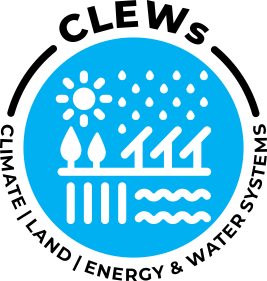
As a framework, CLEWs can be utilized whichever aspect you see it. This also means it applicability to various modelling tools (e.g. the open-source OSeMOSYS), where you can then implement scenario planning, giving stakeholders the capabilities to develop proactive strategies.
The CLEWs framework provides a comprehensive view of resource systems by examining climate, land, energy, and water as interconnected, rather than in isolation. This helps to understand the complex interlinkages between systems and assess where policy, from different sectors, may interact.
As highlighted by some of the studies highlighted on the publications page, CLEWs explicitly connects resource management strategies with broader sustainability goals. This therefore, for example, allows for simultaneous assessment of environmental impact, economic feasibility, and social implications.
The CLEWs Framework is backed by international organizations like UNDESA and IAEA, which are actively building technical capacity, especially in developing countries. This support enhances the framework's credibility and potential for global implementation.
CLEWs is being increasingly incorporated into higher education curricula, which ensures the development of a new generation of environmental professionals which trained in systemic, nexus thinking approaches to sustainable development issues.
International organizations like UNDESA and IAEA are promoting CLEWs through capacity building in the global south, and the framework is increasingly being incorporated into higher education curricula. While CLEWs can be applied using various modelling tools such as OSeMOSYS and LEAP, challenges remain in tool accessibility and building technical capacity, with both becoming key areas of development in recent years.


.png)